How Long Does It Take to Learn a Bionic Hand?

Learning a bionic hand starts with basic control, then builds toward real daily use. Many users begin learning simple open-and-close movements during early fitting and training, but using a bionic hand confidently in everyday life usually takes weeks to months, with full automatic mastery commonly developing over three to six months.
The longer goal is different: using the hand with less conscious effort during activities such as holding a cup, using a phone, preparing food, or managing work tasks.
For upper-limb amputees learning to use a myoelectric hand and for clinicians, prosthetists, and rehabilitation teams guiding that process, the timeline matters because it sets realistic expectations for training, fitting, and day-to-day progress.
The exact pace depends on the person’s residual limb, muscle signals, socket fit, clinical training, device configuration, and how often they practice.
Aether Biomedical’s ecosystem is designed to support this learning process through the Zeus hand, Aether MyoSense, and the Aether Digital Platform. This article explains the stages of bionic hand control, what affects how fast users improve, how pre-fitting muscle training and grip customization can help, and how clinicians use digital tuning and ongoing support to help users integrate the device into daily life.
Zeus hands are fitted and configured by qualified clinicians, with sockets provided by clinical teams rather than Aether Biomedical.
What Is the Standard Time Frame for Learning Basic Myoelectric Movements?
Basic myoelectric control usually begins with learning how to send clear muscle signals. A bionic hand responds to signals from the user’s residual muscles, so the first stage is about finding, repeating, and controlling those signals.
Early practice often focuses on:
Opening the hand
Closing the hand
Stopping movement on purpose
Relaxing the muscle after a command
Repeating the same signal without strain
This first stage can feel unusual because the user is not moving a biological hand. They are learning to contract a specific muscle group in a way the prosthetic system can read. Immediate visual feedback helps. When the user sees the bionic hand respond to a muscle contraction, it becomes easier to connect the signal with the movement.
That first response can build confidence, but it is only the beginning. Basic movement is not the same as automatic daily control.
Why Does Full Automatic Mastery Take Three to Six Months?
Full mastery takes longer because everyday tasks are more complex than clinic drills, and mastering the device for everyday use typically takes 3 to 6 months of therapy. Opening and closing the hand is one skill. Using the hand while cooking, typing, holding tools, carrying objects, or switching between grip patterns is another.
Over time, users build muscle memory. Daily practice and structured exercises help speed motor learning and make that muscle memory more reliable.
At first, they may need to think carefully about every signal. With repetition, the process can become more familiar. The goal is for the user to spend less mental energy on control and more attention on the task itself.
A major part of this stage is unlearning old compensations. Before receiving a bionic arm or bionic hand, many people develop ways to complete tasks without a prosthesis. They may pin objects against the body, rely heavily on the sound limb, or avoid two-handed tasks.
Those habits can be useful before fitting, but they may slow prosthetic integration if the user keeps relying on them.
That is why training is not only about the device. It is also about changing daily movement habits. Regular occupational therapy has a major effect on how efficiently users learn device control, and it supports the broader rehabilitation process.
A Practical Bionic Hand Training Timeline
Training Stage | Main Focus | What Progress Looks Like |
First fitting sessions | Basic signal control | The user learns to open, close, and stop the hand during sessions that commonly last 1 to 2 hours daily |
First few weeks | Repetition and simple tasks | The user practices grip timing, learns to wear the prosthesis and remove it safely each day, and builds common daily actions |
Months 1 to 3 | Routine building | The hand becomes part of regular home, work, or therapy tasks |
Months 3 to 6 | More automatic use | The user needs less conscious effort for familiar activities |
Ongoing | Fine-tuning | The clinician adjusts settings as the user’s needs and signals change |
Basic movement practice usually starts with lightweight objects before progressing to harder tasks.
This timeline is not fixed. Some users progress faster. Others need more time, especially if signal strength, fatigue, socket comfort, or task complexity affects training.
How Does Pre-Prosthetic Fitting Muscle Training Shorten the Overall Timeline?
Pre-fitting muscle training can make the early learning stage easier. Before the final bionic hand is fitted, clinicians may work with the user to identify and strengthen the muscle signals that will control the prosthesis.
The goal is signal separation. The user learns to activate one muscle channel without accidentally triggering another. This matters because clean signals make the hand easier to control.
A well-fitted socket supports consistent electrode contact during prosthetic fitting, which can improve responsiveness in training as the residual limb’s shape changes less under load.
Pre-fitting training may help the user:
Build stronger residual muscle contractions
Practice opening and closing signals separately
Reduce accidental co-contraction
Improve endurance before device fitting
Enter the final fitting with clearer control patterns
A user who already has strong, repeatable signals may spend less time struggling with basic coordination after the hand is fitted.
How Do Aether MyoSense Electrodes Flatten the Early Learning Curve?
Aether MyoSense is designed for accurate signal capture and control. Aether Biomedical describes it as an advanced electrode system that can be used as part of an integrated solution with Zeus hands and the Aether Battery System, including setup work that supports a myoelectric prosthesis.
In practical terms, better signal capture can make training feel less tiring. Proportional control can let users vary hand movement based on muscle tension, which may make responses to electrical signals feel more natural.
If the system accurately reads the user’s muscle activity, the user may not need to overcontract or strain as much to produce a response.
Aether’s product catalogue describes MyoSense as a dual-channel EMG acquisition system with independent measurement channels, adjustable smoothing, real-time skin-contact monitoring, and integration with the Aether Digital Platform. It also describes the MyoSense housing as IP67-rated for water and dust resistance.
This should be understood carefully. That rating applies to the MyoSense housing as documented by Aether. Users should still follow their clinician’s instructions for the complete prosthetic system and avoid assuming the full bionic hand setup is suitable for wet environments.
How Do Intuitive Grip Configurations Prevent Cognitive Training Fatigue?
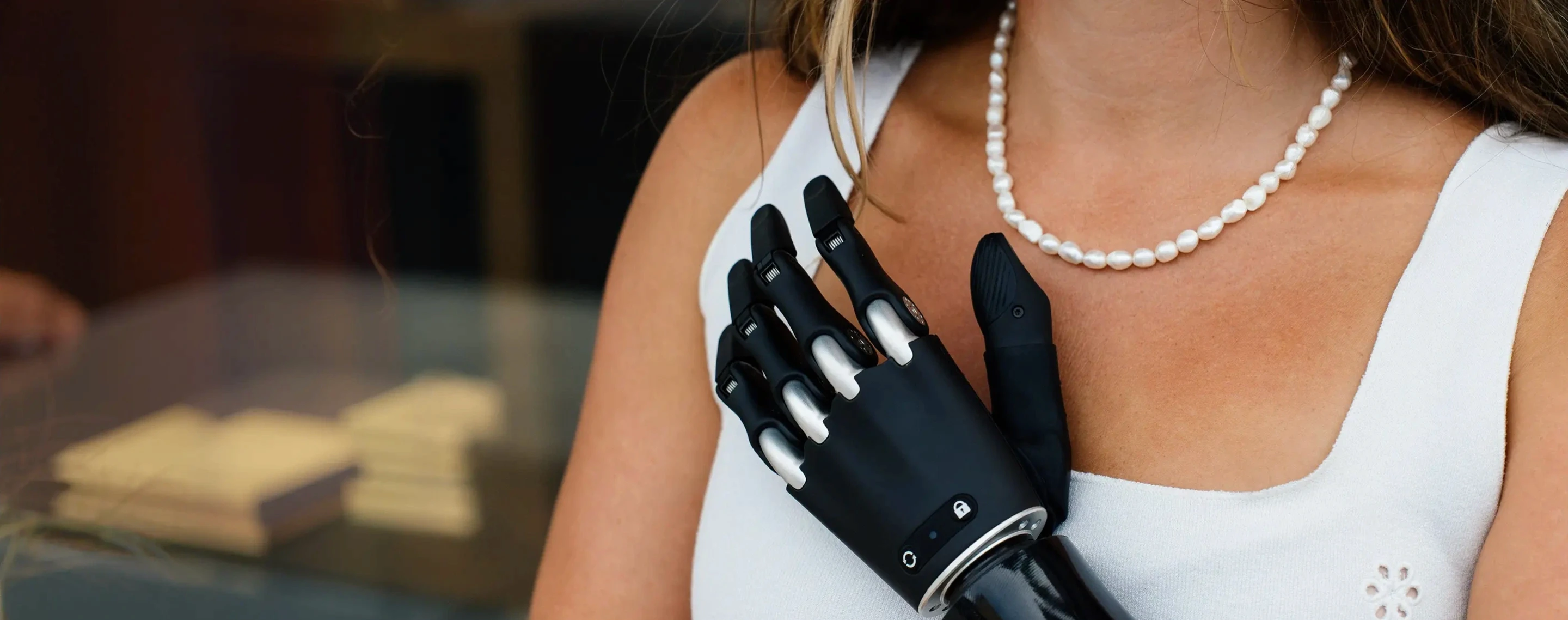
A multi-articulating bionic hand is designed to mimic human hand movements using myoelectric signals, but more options can also create more mental work. If a user has to think through too many steps to reach the right grip, training can become tiring.
The Zeus hands offer 14 predefined patterns alongside 10 configurable grip patterns, with each finger completely customizable to support your unique usage profile.
This helps clinicians tailor the setup around the user’s actual routine. Instead of training around every possible function at once, the user can focus on the grip patterns they need most often and build ability gradually.
Examples may include grips for:
Holding a cup
Using a phone
Carrying a bag
Managing utensils
Operating a spray bottle with a Trigger Grip
Supporting daily tasks
Finger and thumb configuration also affects how naturally the hand can grasp common items.
Zeus hands are intended for mild-to-moderate daily activities. Users should consult their clinician before demanding, unusual, or specialized activities.
How Does the Aether Digital Platform Speed Up Clinical Tuning?
The Aether Digital Platform speeds up clinical tuning by enabling cloud-based remote configuration and real-time remote monitoring interfaces. This connected web system allows certified clinicians to analyze signal performance history and adjust electrode thresholds instantly from a distance, saving the user from frequent, time-consuming travel to a physical facility.
This matters because muscle signals can change. As the user practices, gains strength, or changes daily routines, the original settings may need adjustment. Without remote support, small tuning changes can require extra clinic visits.
Aether states that the Digital Platform supports remote configuration and real-time monitoring. It can track data such as grip cycles, EMG peaks, and grip switches. Patients can also connect through a dedicated mobile app to adjust clinician-established settings within the configured range.
That can make the learning process more responsive. The clinician can adapt settings as the user progresses instead of waiting for every small issue to become a bigger training barrier.
What about the bionic hand and Prosthetic Arm Cost and Price?
Financial investment and overall procurement costs for a bionic hand should never be treated as fixed or universal numbers. Component pricing varies substantially based on regional medical regulations, specific clinical service pathways, customized socket designs, and individual component choices. Because clinical margins and overhead models differ significantly from one prosthetic facility to the next, a definitive cost can only be determined and provided by the specific clinic and fitting prosthetist handling the patient's care.
Advanced prosthetics usually provide better functionality but come at a higher price. Aether Biomedical does not manufacture sockets, and sockets are provided by clinicians. Fitting and adjustment costs are usually additional to the device price. Most prosthetics need replacement every 3–5 years.
For users comparing a bionic hand, bionic arm, robotic hand, or bionic robot hand, the more useful question is not only the price. It is whether the complete clinical solution fits the person’s needs.
Important questions include:
Who will fit and configure the hand?
What training support is available?
How will grip settings be personalized?
Can settings be adjusted remotely?
What service pathway is available?
Does the solution match mild-to-moderate daily activity goals?
Insurance coverage varies widely by provider, so users should review what insurance covers before making decisions about a prosthetic arm.
A qualified clinician can help answer these questions based on the user’s limb presentation, goals, and fitting requirements.
FAQs
Can You Learn How to Use a Bionic Hand on the Very First Day?
Yes, some users can begin learning basic control on the first day of fitting or training, and some may begin shortly after fitting with simple exercises. This usually means learning simple open-and-close movements in first-day sessions that may last 1 to 2 hours, not full daily mastery.
Why Do Aether MyoSense Electrodes Make Prosthetic Training Less Exhausting?
Aether MyoSense is designed for accurate EMG signal capture and control. Clearer signal capture can reduce the need for excessive muscle effort during early training, depending on the user and clinical setup.
How Do Customizable Grip Settings Save Time During Everyday Use?
Customizable grip settings let clinicians configure the Zeus hand around the user’s daily activities, though users should still expect some limitations and practice time even with customized grip settings. This can reduce the need to work through unnecessary grip options during routine tasks. Matching grips to the tasks the person needs most often can improve functional use.
Do I Need to Visit a Clinic Every Time My Residual Limb Muscle Signals Change?
Not always. The Aether Digital Platform supports remote configuration and monitoring by clinicians. Your clinician will decide which adjustments can be handled remotely and which require an in-person visit.
What Factors Cause an Amputee to Abandon Myoelectric Device Training?
Common barriers include fatigue, inconsistent signals, discomfort, lack of confidence, poor task fit, and settings that do not match the user’s routine.
For some users, body-powered prosthetics may be a better fit because they use a harness and cable for control through the upper arm, shoulder, and chest. Passive cosmetic prosthetics focus more on appearance than function, which can influence long-term training decisions.
Clinician-guided fitting, training, and tuning are important because the device must work for real daily life.
Is It Difficult to Learn How to Handle Fragile Objects Safely?
It can take practice. Fragile objects require grip timing, controlled closing, careful positioning, and confidence. Users should build these skills gradually with clinical guidance.
Conclusion
The rehabilitation process of learning a bionic hand happens in stages of adaptation after limb loss or upper limb loss. Basic myoelectric movement can begin early, but confident daily use usually takes repeated practice over weeks and months.
Aether Biomedical supports this process through clinician-fitted Zeus hands, Aether MyoSense signal capture, customizable grip patterns, and the Aether Digital Platform for remote configuration and monitoring.
Understanding the device’s functional ability, limits, and care instructions is essential for long-term success.
To explore whether a Zeus hand setup is right for your needs, start with a qualified clinician, who can help explain how cost, fit, and future needs may affect the recommended solution, and review the full Aether ecosystem: the Zeus hand, Aether MyoSense, and the Aether Digital Platform.

Read On
See Zeus in action across clinical settings worldwide