How Strong Are Bionic Prosthetic Hands? Lifting Limits

Imagine holding a cold, heavy cast-iron skillet or gripping a physical railing as you move down a steep ramp. For individuals navigating the path of limb loss, these moments require real mechanical durability and predictable device control.
The world of advanced technology is changing very fast, but what most people think they know about robotic limbs is still stuck in the past. We frequently encounter outdated, highly dramatized stories that give people the wrong idea about what a modern robotic hand prosthetic can actually do.
When we listen to conversations about advanced artificial limbs, it is easy to spot a lot of incorrect information regarding total load limits and daily durability. Science fiction has painted a picture of bionic arm options that are either capable of crushing solid stone or, conversely, are as fragile as a piece of decorative glass.
This big gap between our imagination and real life makes things confusing for doctors, families, and the people who need these tools to return to daily activities. We believe it is time to clear up the confusion and look at the real engineering facts behind how strong bionic prosthetic hands are.
By looking closely at how these modern hands are built, we can break down the myths that keep people from understanding true mechanical limitations. Real progress relies on honest facts, clear measurements, and true stories about how these bionic prosthetics perform when subjected to real physical stress.
Let us dive right into the most common questions and discover the amazing engineering that brings a modern bionic hand to life.
What mechanical metrics define the closing strength of a bionic hand?
Measuring Peak Grip Force Thresholds in Newtons
True bionic strength is measured by the constant closing force the fingers exert on an object, rather than just raw carrying capability. When evaluating how strong bionic prosthetic hands are, engineers look directly at the steady clamping pressure generated by the internal motorized drive systems.
This active squeeze determines how well a device can hold onto a slippery object or grip an item without letting it slide out of the fingers.
The Performance Profile of Leading Models
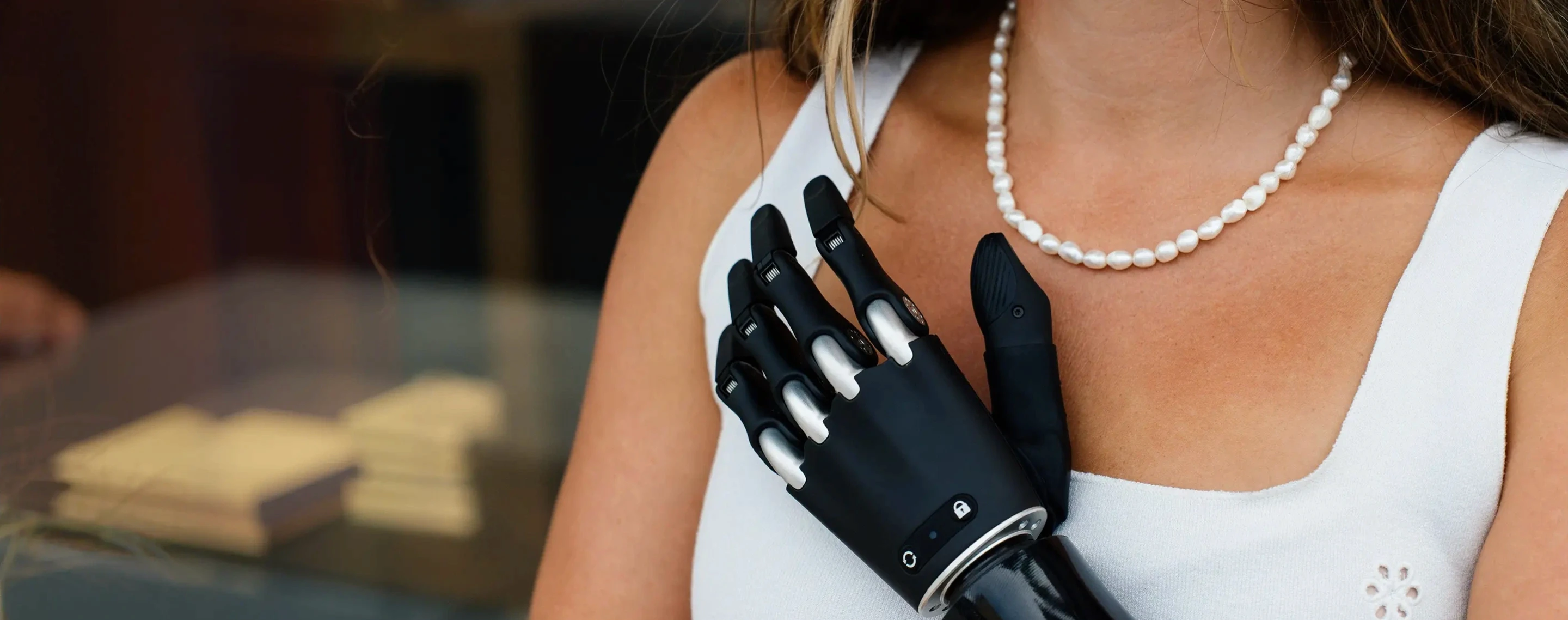
The real numbers from the technical specification sheet show that modern robotic hands are built for both great power and careful control. In the standard robust build of the Zeus hand developed by Aether Biomedical, the system delivers an industry-leading high-output grip force threshold of up to 152 Newtons (34.17 lbf) of active pressure.
This force ensures that users can tightly grip heavy objects, sports equipment, or manual workshop tools with complete confidence. For individuals who require a lighter bionic hand performance, the smaller variant provides a robust 120 Newtons of active grip force tailored for everyday agility and comfort.
Proportional Closing Speed Integration
Working alongside this structural strength is an intelligent internal software architecture that perfectly balances closing speed with terminal clamping pressure. The standard configuration allows the digits to open or close fully in approximately 1.2 seconds to maintain smooth tracking and natural-looking movement.
In the smaller and more streamlined configurations, this closing time is accelerated down to a remarkably fast 0.8 seconds to give a secure sense of speed. This immediate responsiveness creates a more intuitive control experience, allowing the user to manage the hand with less deliberate strain.
How much raw weight can a modern myoelectric prosthetic device lift and carry?
The Biomechanics of the Functional Hook Grip
The way an artificial limb handles a vertical load depends heavily on clever mechanical shapes rather than just drawing continuous battery power. When an individual lifts a heavy travel bag or a basket, they typically utilize a specific hook grip load capacity for amputees.
This posture allows the multi-articulating fingers to sustain heavy vertical loads by mechanically locking the joints into position against the frame.
Because the fingers lock themselves in place physically, the heavy weight rests securely on the structure without draining the battery or stalling the internal motors.
Static Vertical Carrying Capacity Limits
The physical lifting boundaries of different form factors show how modern engineering accommodates diverse lifestyle needs. The standard build of the Zeus hand features a remarkable myoelectric prosthesis lifting capacity of up to 35 kilograms (77 pounds) when executing a functional hook grip.
This high capacity allows users to comfortably move heavy luggage, carry large grocery bags, or move boxes around a home or office. For individuals utilizing the compact build, the system delivers a lift capacity of up to 20 kilograms to support daily lifting tasks.
The Versatility of Predefined Grip Configurations
To ensure that heavy loads do not warp or break individual components, the system utilizes specialized selections out of 14 predefined grip patterns.
These diverse options enable individuals to tailor the device’s physical shape to match specific tasks, ensuring that weight is distributed safely across the palm, thumb, and independent digits depending on object shape.
This structural versatility prevents clumsy slips and irregular object handling while protecting the finger joints from focused tension.
How do independent motorized digits prevent high-strength bionics from crushing fragile items?
The Principle of Individual Motor Stalling
We often encounter the fear that a high-strength bionic prosthesis will accidentally crush delicate everyday items like plastic cups or fresh food because of its raw power.
This low-strength mechanical limit myth is busted by the principle of individual multi-articulating finger stall force management.
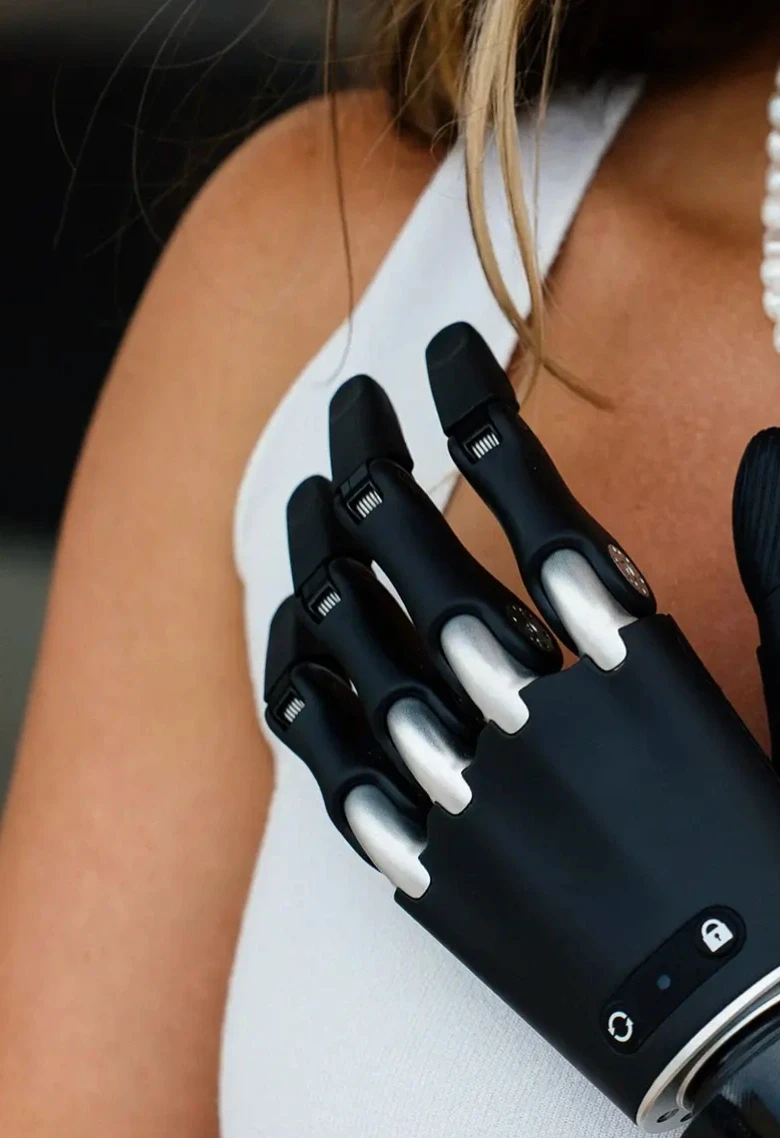
Each finger is driven by its own self-contained motor, allowing the digits to move and stop all on their own.
Automatic Conformity Around Complex Geometries
This independent mechanical stopping allows the hand to wrap securely and evenly around irregular objects without requiring manual programming overrides. Think about holding an item like a handle, a delicate wine glass, or a fresh egg. Instead of forcing the item into a rigid shape, the robotic hand shapes itself naturally around the contours of the object to maximize surface contact.
This automatic compliance ensures a secure grasp while distributing the holding forces safely across the entire surface of the item.
Modulating Force via Advanced Biosignal Inputs for Precise Control
Connecting this conforming mechanism to proportional signal control gives users the confidence to manage fragile household objects safely.
Sensors placed inside the custom-molded socket wall read the small electromyography inputs from surface sensor arrays produced by muscle contractions in the user's residual limb.
By capturing clean, high-fidelity muscle data, the processing software translates muscle intent into immediate physical motion. Users can modulate speed and force proportionally based on the strength of their signal input, scaling down easily to a soft grip for delicate tasks.
Why is impact resistance just as critical as raw lifting strength for durability?
The Hidden Risk of Rigid Mechanical Frameworks
Historically, a major weakness of advanced upper-limb prostheses was not their lack of lifting strength, but their vulnerability to sudden drops or side impacts.
Older generations of high-strength prosthetics featured rigid internal gears that would shatter instantly during real-world bumps because the unyielding components could not absorb kinetic energy. If a user accidentally bumped their hand against a door frame or dropped a tool, the force would snap the internal drivetrain.
This vulnerability often meant packing the device into a box and shipping it away to a far-off factory for lengthy repairs.
The Engineering of Joint Compliance Mechanisms
Modern bionic hand structural compliance engineering addresses this historical weakness by implementing highly advanced impact-resistant compliance mechanisms directly into the finger joints. In contemporary devices like the Zeus portfolio developed by Aether Biomedical, the individual digits are not rigidly locked into a fragile layout.
Instead, a patent-pending impact resistance mechanism allows the individual fingers to flex and bend naturally when they hit something hard, absorbing the energy of the bump and bouncing back into alignment instead of snapping internal gears.
This structural compliance allows the hand to absorb unexpected shocks instead of breaking, helping the bionic robot hand last a very long time through normal daily play and work.
Minimizing Downtime Through On-Site Component Swapping
This robust architecture segments into interchangeable plug-and-play components, introducing the massive advantage of local clinical serviceability directly to the patient's community.
Because the entire prosthetic bionic hand features 100% repairability on-site, an authorized clinician can perform complete modular repairs inside their local facility. If a single independent digit suffers an extreme impact that damages a component, the clinician simply opens the chassis to swap out the specific module or torsion springs directly.
This rapid in-office workflow reduces patient clinical downtime significantly, enabling a certified clinician to perform complete modular repairs locally in under 10 minutes for smaller builds and under 30 minutes for standard builds by swapping fingers or torsion springs directly.
This on-site model eliminates the need to live without a hand for weeks while a device sits in a remote factory.
What are the real-world operational boundaries of high-strength bionic hands?

Strict Environmental Moisture and Water Restrictions
While modern upper-limb technology is extraordinarily capable and strong, we believe it is essential for users to maintain a clear, realistic understanding of current physical boundaries. Despite their rugged construction and high active grip force, these precise electronic systems are not waterproof.
They must never be exposed to wet environments or total submersion in swimming pools, bathtubs, or deep sinks. Liquid entering the inner electronic core can damage sensitive components and cause an immediate short-circuit, so users must clean their hands using specialized wipes instead of running water.
Exclusion of Industrial Machinery and Heavy Equipment Operation
Mandatory clinical safety guidelines state that bionic limbs are intended strictly for mild-to-moderate everyday activities and are not certified for heavy industrial workloads. Users must recognize that passive knuckle static weight limits and active force limits are designed for daily functional mobility, not industrial construction machinery.
The hand is not strictly intended for suspension training, extreme sports, or operating heavy power tools that generate severe, continuous mechanical vibrations. Adhering to these safety boundaries ensures the long-term structural integrity of the device and prevents unexpected accidents or physical strain on the user’s residual limb.
The Role of Specialized Function Grips
To operate daily appliances safely without overstressing the hand, users can utilize specific configurations out of the available grip profiles.
For example, selecting the Trigger Grip allows for the safe management of spray bottles, while the Key Grip securely holds thin, flat items like keys or credit cards between the thumb and the side of the index finger.
Utilizing these targeted configurations ensures that the mechanical forces are balanced perfectly for the task at hand, preventing unnecessary torque on individual joints. This structural predictability provides reliable performance, making daily physical tasks feel far more secure.
FAQs
How strong are bionic prosthetic hands compared to a natural human grip?
Bionic hand strength depends on the model and clinical setup. Zeus V1 provides up to 152 N / 34.17 lbf of grip force, while Zeus V2, available as Zeus S and Zeus M, provides 120 N / 26.97 lbf with a faster 0.8-second closing time. Both hands are designed for mild to moderate daily activities and should be used according to clinician guidance.
How many pounds or kilograms can a modern myoelectric bionic hand safely lift?
Lifting capacity depends on the specific hand model and setup. Zeus V1 has a static grip capacity of up to 35 kg / 77 lb when using Hook Grip, while Zeus V2, available as Zeus S and Zeus M, has a static carrying capacity of up to 20 kg / 44.96 lb. Both hands are intended for mild to moderate activities, and users should follow clinician guidance for safe use.
Why does a bionic hand's lifting strength depend directly on self-locking finger mechanics?
When a user carries a heavy load vertically, the self-locking design of the multi-articulating fingers allows the digits to maintain their physical hold mechanically.
This structural layout ensures that the heavy weight is supported entirely by the frame of the hand, allowing the device to sustain heavy vertical loads without drawing continuous battery power or overheating the internal motors.
Can a bionic hand withstand the weight of a user pushing up from a seated position?
Yes, the physical structural integrity of the hand chassis is built to withstand substantial load capacities during daily movements. The standard frame can tolerate significant static force on its chassis to support the user when leaning on a flat surface or pushing themselves up from a chair, provided the wrist is maintained in a neutral position and the force is perpendicular to the surface.
What prevents a high-strength bionic prosthesis from accidentally crushing delicate objects?
The hand utilizes independent motorization for each finger, allowing the digits to stall automatically the exact moment they meet physical resistance.
Furthermore, by processing clean muscle signals from surface sensor arrays, users can precisely modulate hand speed and power proportionally based on the strength of their muscle contractions, scaling down easily to a soft grip for delicate items.
Are heavy-duty bionic hands completely shockproof and resistant to accidental drops?
While no device is completely indestructible, modern bionic hands incorporate impact-resistant compliance mechanisms inside the finger joints. This structural compliance allows the individual fingers to flex and bend naturally under a sudden external shock or drop, absorbing the energy of the bump and bouncing back into alignment instead of snapping internal gears.
Can I use a high-strength bionic hand to operate heavy industrial construction machinery?
No. The Zeus hand is intended for mild-to-moderate daily activities and should not be used for heavy industrial work, extreme sports, suspension training, operating heavy construction machinery, or other high-impact activities. We recommend that users consult their clinician before performing any specialized or demanding activities with the Zeus hand.
Conclusion
True durability comes down to a balance between raw power, smart software, and impact-resistant engineering. Modern innovations ensure that users no longer have to settle for fragile hardware or slow, rigid movements during their day.
By tracking real muscle signals and relying on durable, self-locking mechanics, these devices handle real-world challenges while remaining incredibly easy to manage.
If you are ready to explore your upper-limb options and want to see how these advanced engineering choices fit into your daily routine, take the next step. Contact Aether Biomedical today to schedule a consultation.

Read On
See Zeus in action across clinical settings worldwide